
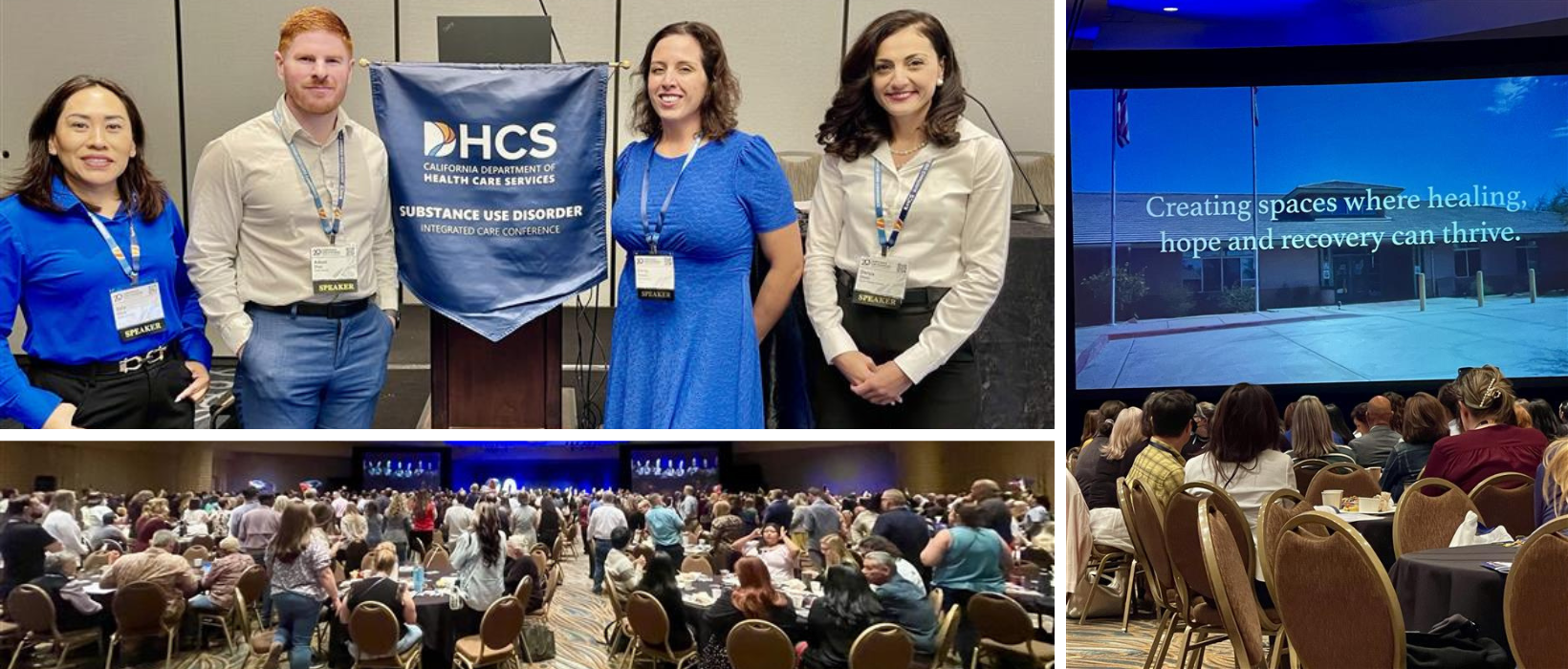
This year, the 20th anniversary of the Department of Health Care Services SUD Conference was held from September 24th to 27th at the Hyatt Regency in Long Beach, California. The Horizon team, along with Emily Hosea, Director of the CARF Behavioral Health Division, presented on Measurement-Based Care and Why it Matters for Effective Clinical Practices.

While our presentation proudly shared data that affirmed our impact on clients lives by showing reduction in anxiety and depression symptoms over time during their stay at Cronin House, Horizon marked itself as a thought leader with its ability to integrate technology, operational workflow and clinical expertise through the predictive signal analysis tool, a home-grown tool thanks to our genius IT team.
Horizon was approached by the UCLA research and development department contracted via the DHCS with an invitation to turn our presentation into a review article for publication in high impact journals such as the American Psychiatric Association as well as Journal of Substance Abuse Treatment. The invitation came from our ability to show that with our predictive signal analysis, our ability to predict which clients are prone for early discharge (aka: flight risk) empowers our team to intervene and offer support to those clients. This was uplifted as Horizon’s person-centered approaches and its marriage with evidence-based forward thinking technology tools. And of course, this was an opportunity to highlight the importance of working as multidisciplinary teams as the opportunity to offer our presence with clients is a joint collaborated and coordinated effort from IT flagging and email distribution to operational follow through and clinical support.
In addition to highlighting how this predictive signal analysis empowers person-centered approaches that ultimately aim to ensure client retention, we were able to wow the audience by presenting the tools confidence level. During the presentation, we said, “We had three questions at Horizon.
1) Which clients were at risk for early discharge?
2) Why? [i.e., organizing their protective and risk factors]
3) How confident are we in our predictions?
Unpacking # 3, we highlighted that the KEEP model is not merely able to send an alert to the Cronin team when a client is flagged but breaks down its confidence from a total of 100%. Specifically, if a client was flagged as a flight risk at a 60% confidence interval, this means they were predicted early discharge within the first 7 days. The KEEP model was also able to show confidence in evaluating how likely that same client would stay 8-22 days and above 22 days.
Not sure where to start? We can help you find the right program in your county. Most services are no cost or covered by Medi-Cal for those who qualify.
Horizon received several questions from the audience regarding the KEEP model, including whether the IT team would be able to use previous data to answer to new clinical questions.
While this was a proud experience with conclusive predictions, we believe Horizon’s embrace of technology, clinical and operational collaboration is only the beginning in marking new tools and measurement-based interventions. For example, we’re currently building upon this model by creating a system that will show us what percent of the clients remains in treatment upon receiving supportive contact from the team when they were first flagged as a client who might be at risk of discharge.

During the presentation, I highlighted how MBC supports clients throughout their treatment journey, particularly when clients begin to get “off track” from their established goals. MBC provides objective data that helps clinicians identify changes in client functioning early, creating opportunities for intervention before challenges escalate.
A key focus of the presentation was how MBC promotes client empowerment through a client-centered approach vs clinician driven approach. By regularly reviewing survey results and outcome measures, clients are actively involved in understanding their progress, identifying barriers, and participating in treatment decisions, creates meaningful opportunities to strengthen therapeutic relationships and trust between clients and clinicians.
Consistent discussions regarding progress, symptoms, and client feedback foster open communication and validate the client’s experience, making treatment more transparent and responsive to their needs. This collaborative approach increases engagement, accountability, and ownership of clients’ treatment process.
Additionally, MBC provides immediate identification of clients reporting active SI or HI through real-time alerts and flagging mechanisms. This allows clinicians and treatment teams to respond promptly, conduct appropriate triage, implement safety planning, and provide immediate support when risk concerns arise.
Using measurement-based care data from Cronin House we conducted a random-sample review to evaluate changes in depression and anxiety symptoms among clients receiving residential treatment.

The analysis focused on clients who met criteria for at least moderate depression or moderate anxiety at intake, as measured by the PHQ-9 and GAD-7, respectively. Intake scores were compared with scores from each client’s final available assessment during the treatment episode to examine the proportion of clients demonstrating improvement in symptom severity.
Ready to talk to someone? Everyone is welcome here, and there is no judgment in reaching out.
The findings were as follows:
May 2026: Depression symptoms improved by 80% (sample size: 51 clients), while anxiety symptoms improved by 83%.
April–May 2026: Depression symptoms improved by 84% (sample size: 71 clients), while anxiety symptoms improved by 89%.
March–May 2026: Depression symptoms improved by 87% (sample size: 85 clients), while anxiety symptoms improved by 86%.
Overall, the measurement-based care data demonstrate a consistent pattern of improvement in depression and anxiety symptoms among the sampled clients over the course of residential treatment.
I discussed how and when measurement-based care (MBC) data is collected and how it informs the client’s therapeutic journey. At intake, clients complete an initial MBC survey that serves as part of the biopsychosocial assessment process, gathering information related to substance use, mental health, and physical health. Counselors and clients use this baseline data collaboratively to develop an individualized treatment plan that reflects the client’s presenting needs, symptoms, and treatment goals.
Throughout treatment, clients complete updated MBC surveys on a weekly basis. Counselors review patterns and trends in the data with clients during individual sessions, creating opportunities to assess progress, identify emerging concerns, and determine whether adjustments to the treatment approach may be beneficial.
Clinical decision-making is informed by both MBC data and the counselor’s ongoing clinical observations and interactions with the client. As treatment progresses, MBC becomes integrated into the therapeutic process rather than functioning solely as an assessment tool. During this phase, therapeutic engagement is often at its strongest, allowing the counselor and client to collaboratively evaluate progress, address barriers, and refine treatment goals based on both objective data and the client’s lived experience.
Later in the presentation, I discussed a real-world case example that highlighted the importance of balancing measurement-based care data with clinical judgment. In this case, the client’s presentation during individual therapy sessions did not align with what was being reflected in the MBC data. Rather than relying exclusively on the assessment scores, I leaned into his clinical observations, therapeutic interactions, and understanding of the client’s presentation.
The case demonstrated that MBC data is most effective when used as one component of a broader clinical picture rather than as a substitute for clinical judgment. When discrepancies emerge between standardized measures and a client’s presentation in session, those discrepancies can become clinically meaningful points of exploration. In this instance, the therapeutic relationship and ongoing clinical observations provided important context for understanding the client’s needs and determining the most appropriate direction for treatment.
Written by
Adam Diaz is an Associate Professional Clinical Counselor and Associate Marriage and Family Therapist who brings a strong foundation in treating co-occurring disorders and a deep commitment to client-centered care. His journey with Horizon Treatment Services began as…